One record for your child's first five years.
Enter the birth details once. From there, Tumbuh adjusts what's worth tracking to your child's age, from the first feed to their fifth birthday.
The first five years set the course of a life.
It's rarely one big thing. It's small things, noticed late.
- Two months of weight gain stalling, while the growth chart waited for the next posyandu visit.
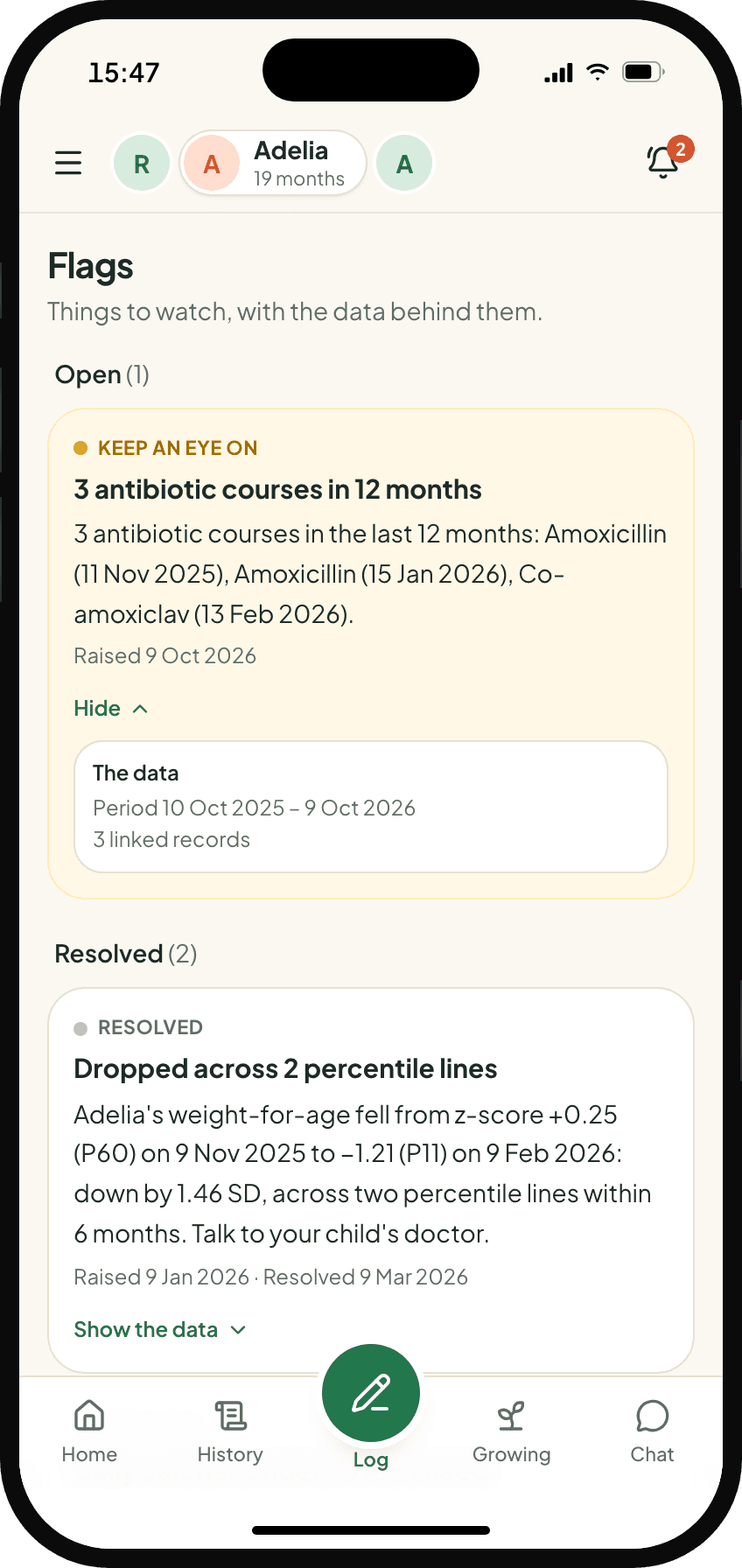
- A fourth course of antibiotics this year, and nobody was counting.
- The 18-month booster, missed because the Buku KIA was in a drawer.
“You'll remember the birthdays. Tumbuh remembers the rest.”
Lost height is hard to win back
Children who are already stunted at 2 mostly don't catch up on height later. That's why Indonesia's Ministry of Health builds its stunting programme around the first 1,000 days.
The brain is growing fastest
By around age 2 or 3, a child's brain is already about 80% of its adult size, and nutrition in these years helps build it.
Extra weight tends to stay
Overweight that starts early often carries on through childhood. Too little and too much both need to be seen early.
Indonesia Health Survey (SKI) 2023, Ministry of Health
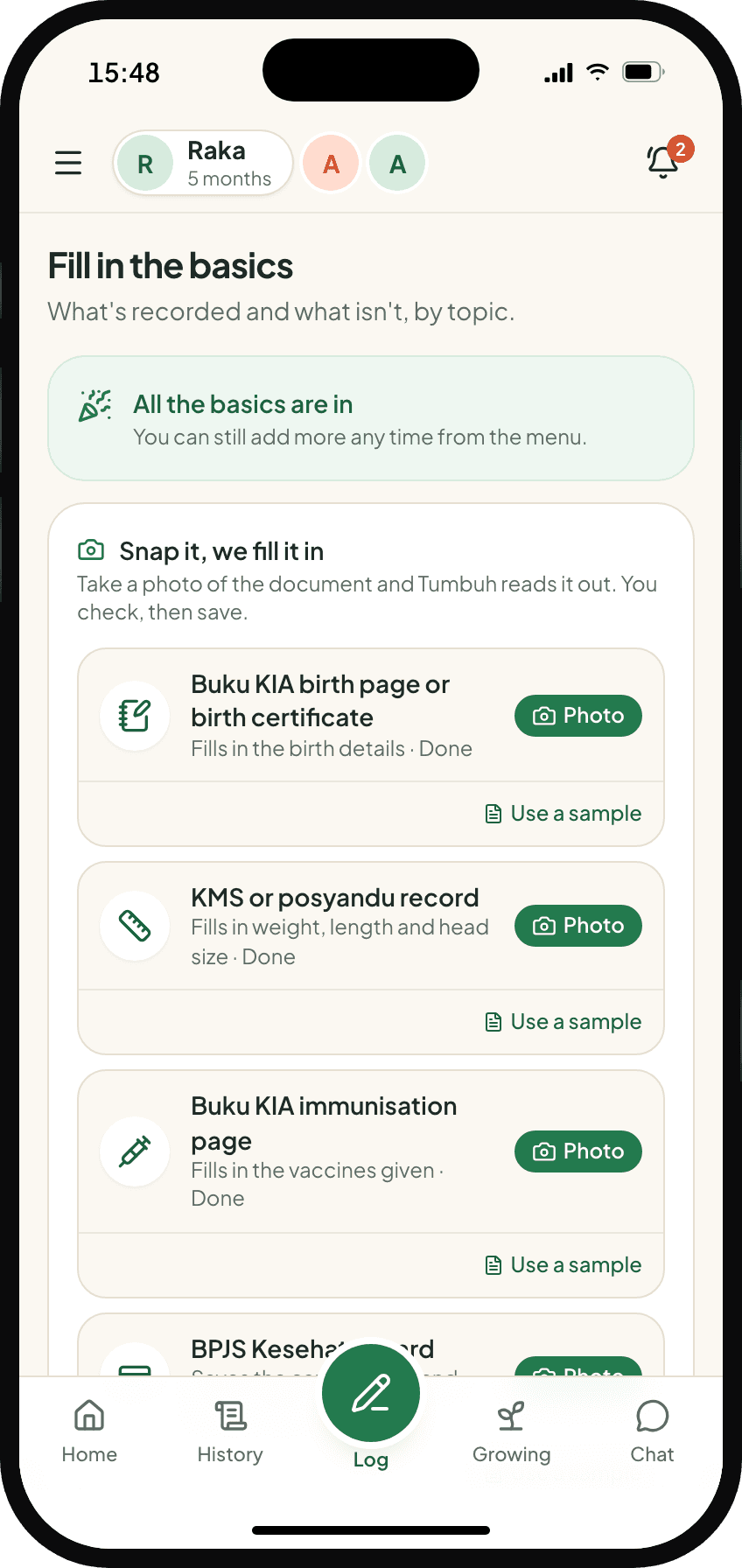
It starts with the birth card.
Photograph the hospital birth card and Tumbuh records gestational age, birth weight and length, head circumference, APGAR score, blood type and newborn screening results. Add both parents' heights for an adult height estimate, plus family history like asthma or thalassaemia.
- ✓Babies born before 37 weeks automatically use corrected age until age 2
- ✓Family history that matters for your child's health
- ✓Entered once, used everywhere
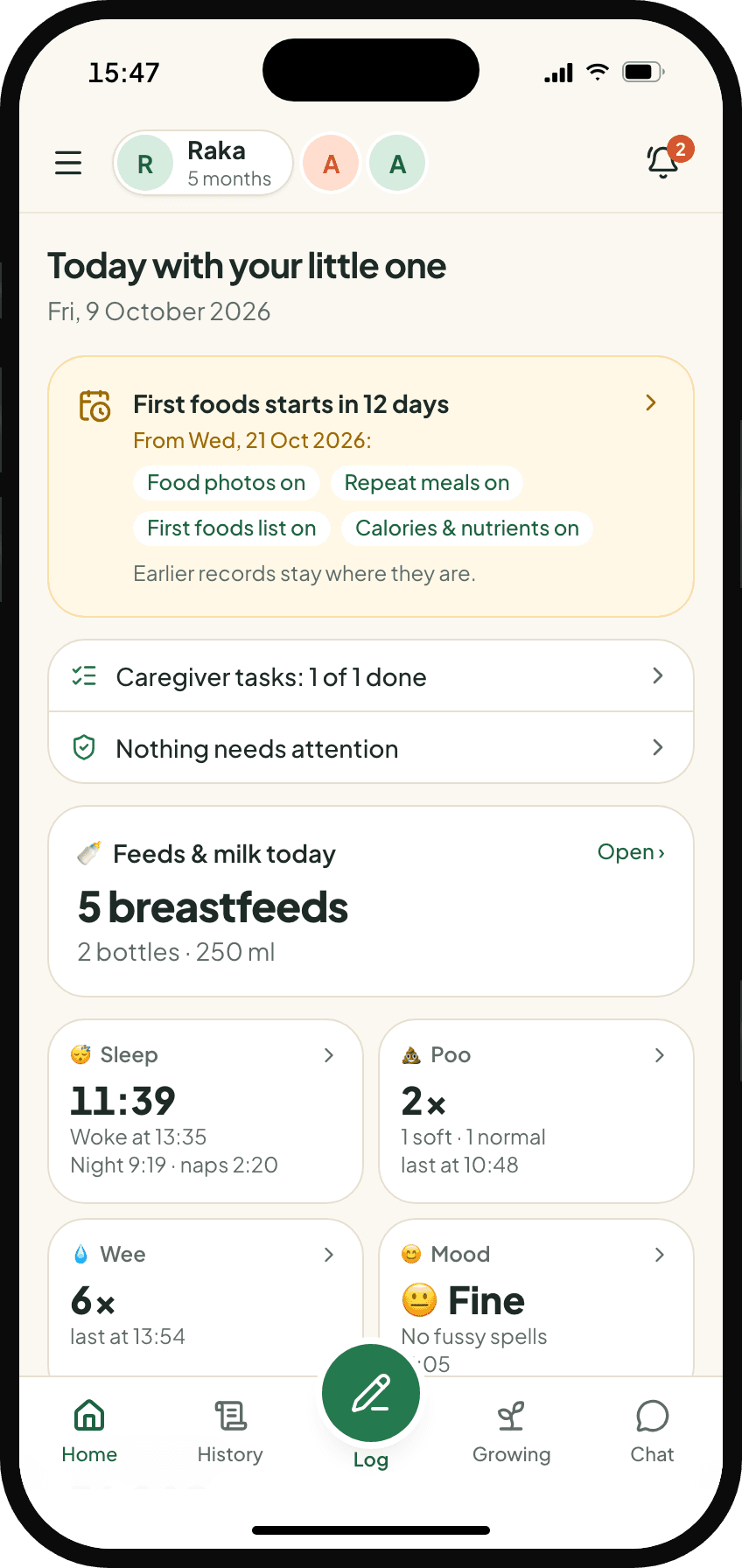
The buttons change as your child grows.
There are four stages across the under-five years, from milk only to age five. A stage only decides which buttons, cards and nutrient targets you see; it never turns into advice. Once your baby starts solids, meal photos switch on and a Repeat row appears: the meals they've eaten most over the last three weeks, logged again in one tap with the nutrients recalculated. Every food tried for the first time lands on a Firsts list by itself, with nothing extra to log.
- ✓Quick log on the home screen: one tap saves it, and Undo is right there
- ✓Set the time first: now, 15 min, 30 min or 1 hr ago
- ✓Bottles come pre-filled with the last amount
- ✓Corrected age for premature babies, plus the dates solids started or breastfeeding stopped
- ✓Sleep and naps in one tap, compared with the recommended range for their age
- ✓Hands full? Say it out loud and Tumbuh writes it up
- ✓Missed something? A reminder, then “Fill in what's missing” catches up in one go, so there are no gaps
Try the demo: pick a role, then an age
- Baby, 0–6 monthsRaka, 5 months
Still on breast milk and bottles. Feeds, bottles and nappies take one tap, and the nanny's day shows up in the Daily report.
Open Raka's demo - Toddler, 1–2 yearsAdelia, 19 months
Born at 34 weeks. Meal photos, a growth chart on corrected age, and one vaccine that's overdue.
Open Adelia's demo - Child, 5 yearsAditya, 5
Five years of records since birth. Meal photos, more sweet drinks than there used to be, and a BMI that's creeping up.
Open Aditya's demo
You'll be signed in as Rina, their mum. See Raka's Daily report →
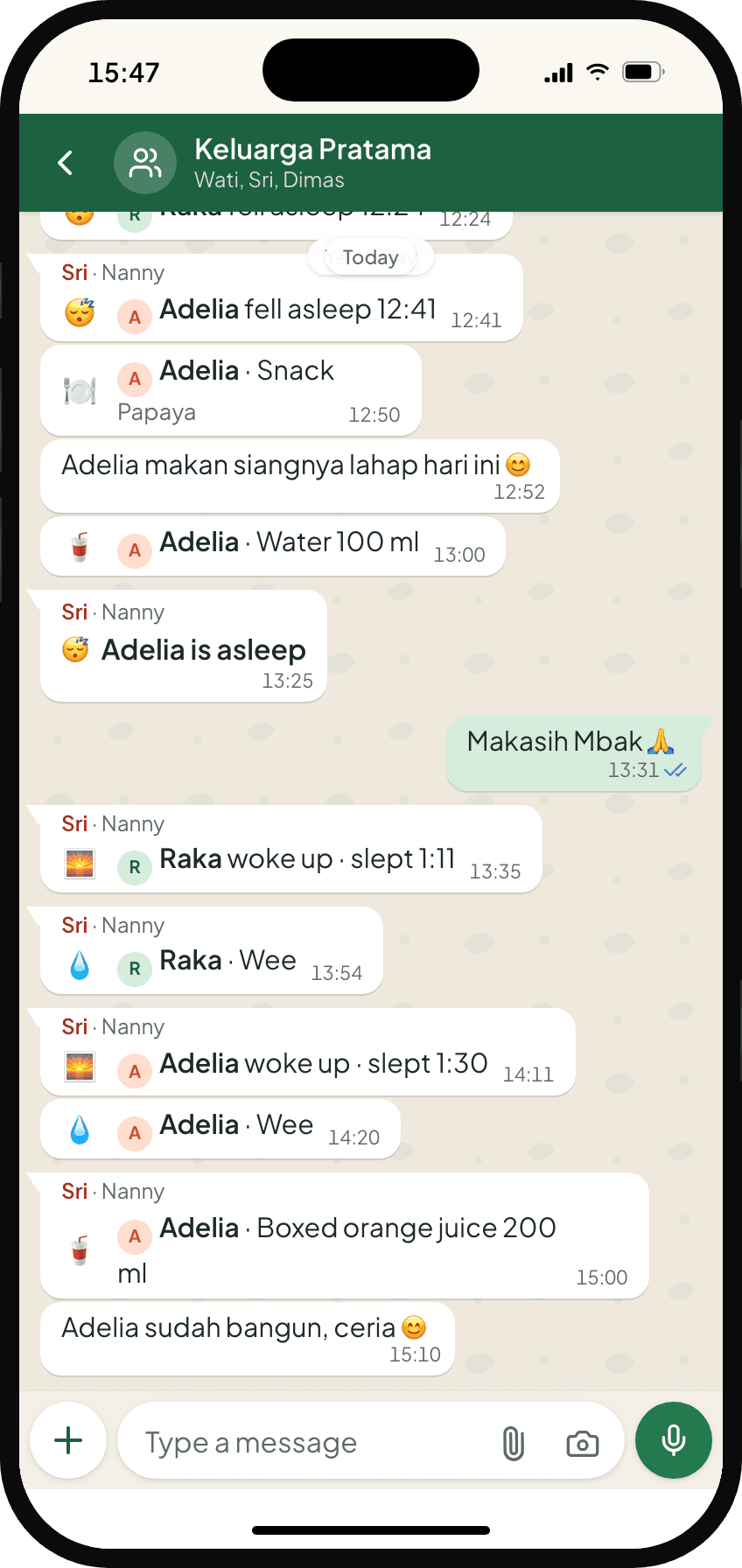
The person with your child all day keeps the record. You still make the decisions.
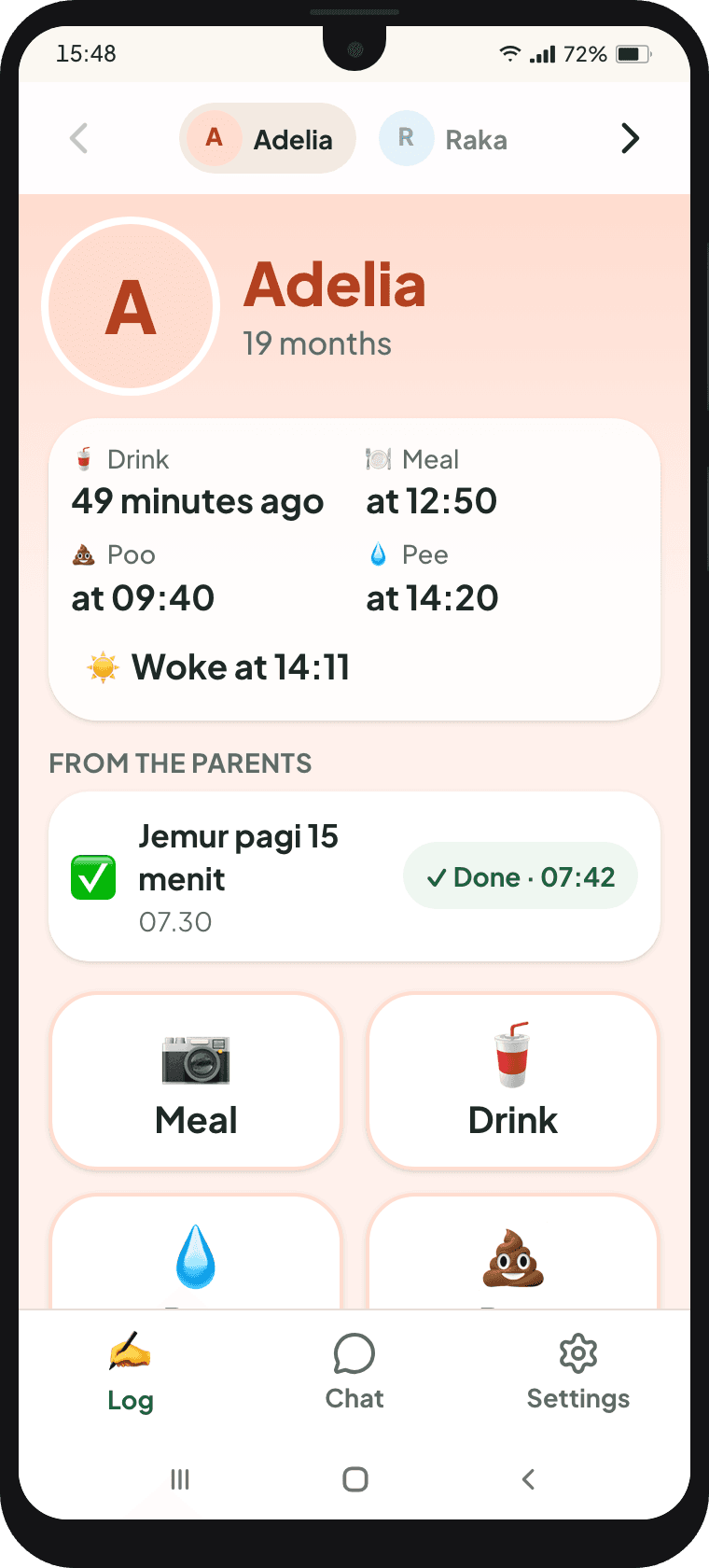
Caregivers get an app of their own: a Log screen with big buttons for the child's age, and the family chat. One tap or one photo, and the card appears in your chat. Everything they log counts towards your child's nutrition, sleep and history, with their name on it.
- ✓One tap, one choice: bottle, meal by photo, drink, wee, poo, sleep, mood, temperature when needed
- ✓Tasks from you, one-off or repeating. The caregiver just taps Done
- ✓One-tap requests in the chat: photo of a meal, check temperature, home time
- ✓The family chat is for talking. Messages never turn into entries; only the buttons log
- ✓Growth charts, weight, flags, documents, doctor visits, Ask Tumbuh and settings are closed to caregivers
- ✓Pause, resume, replace or remove them any time. Their entries stay
- ✓Caregivers are free, however many you have
More than a dot on a chart.
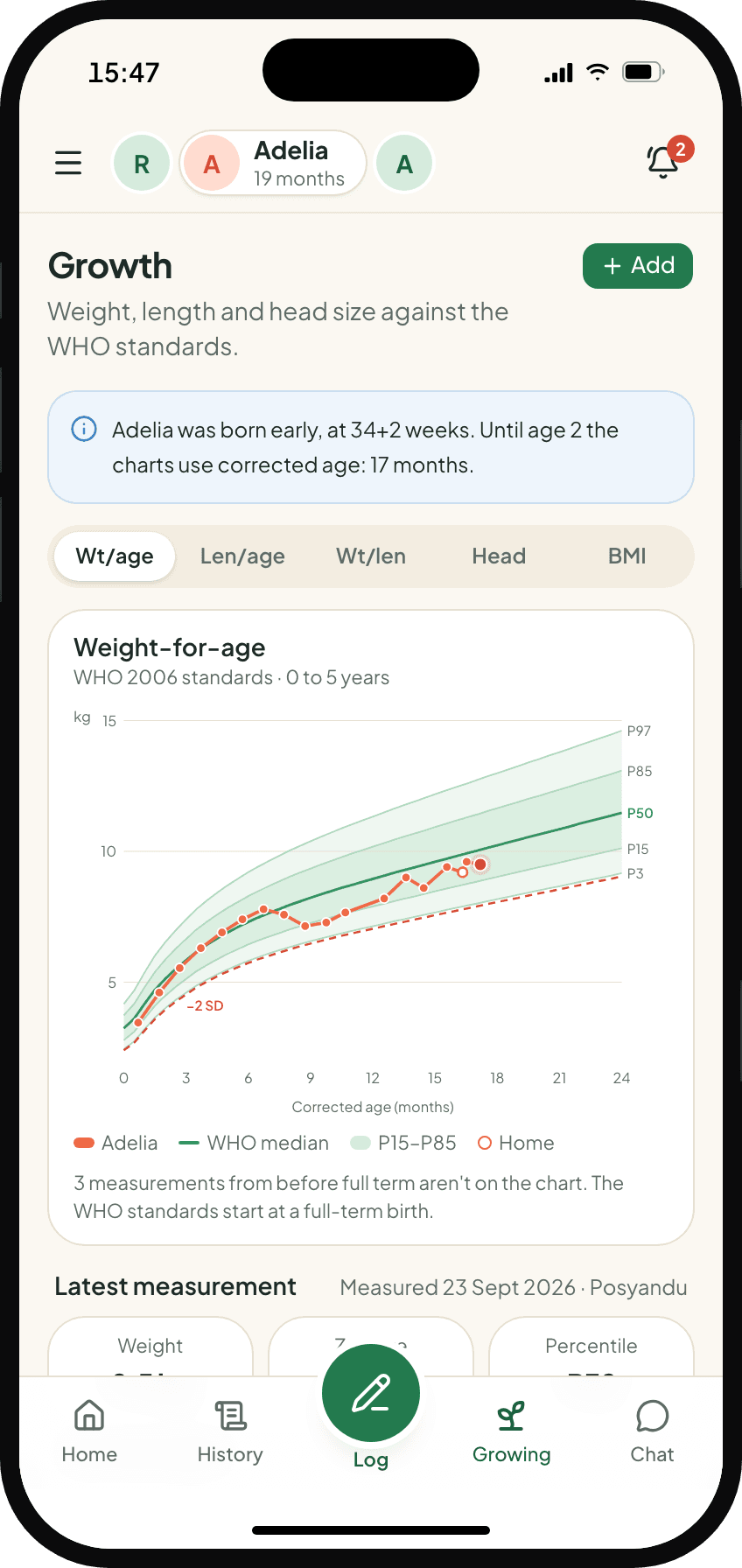
Tumbuh uses the WHO Child Growth Standards (2006) for ages 0–5, as adopted by Indonesia's Ministry of Health. It reads not just where your child is today, but which way they're heading.
- ✓Weight-for-age, length or height-for-age, weight-for-length, head circumference (0–3 years) and BMI (from 2 years)
- ✓Growth speed, plus an adult height estimate from both parents' heights
- ✓From age 3: blood pressure, eye and hearing checks
Calories and nutrients from every food and drink photo.
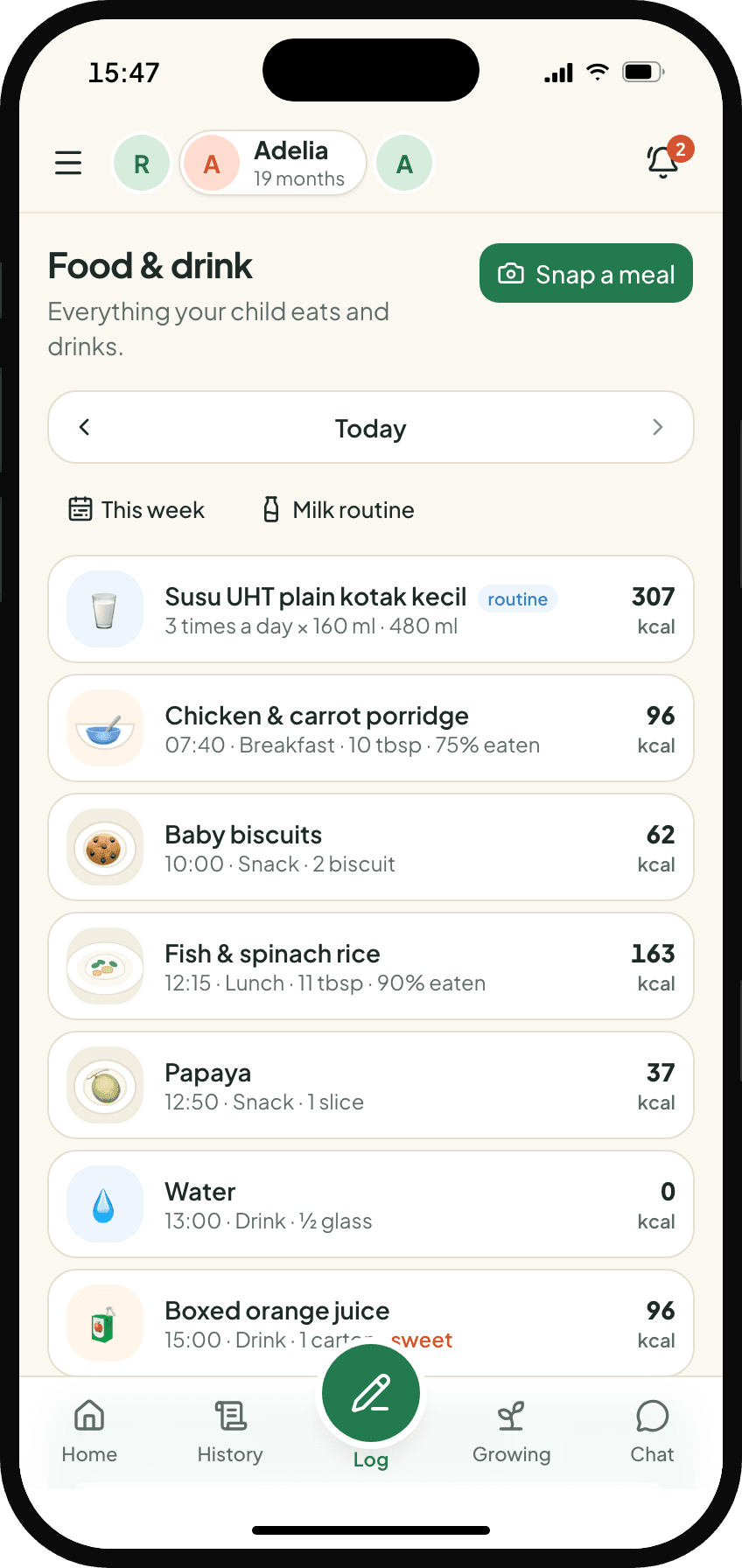
Just take a photo. Tumbuh recognises the food and drink, estimates how much was eaten, then counts the calories and nutrients from Indonesia's food composition table and compares it with the national nutrient targets. You get daily and weekly summaries you can read at a glance.
- ✓0–6 months: one-tap breastfeeds, bottles of pumped milk or formula and nappies, plus vitamin D or iron drops
- ✓6–24 months: solids, textures, food refusal
- ✓All ages: meals, snacks, water and sweet drinks by photo
- ✓Milk from age 1 (formula, UHT): entered once per period, e.g. 3 × 160 ml a day since 1 Oct
- ✓Calories, protein, fat, carbs, sugar, iron, zinc, calcium, vitamins A and D
Too much weight is watched too.
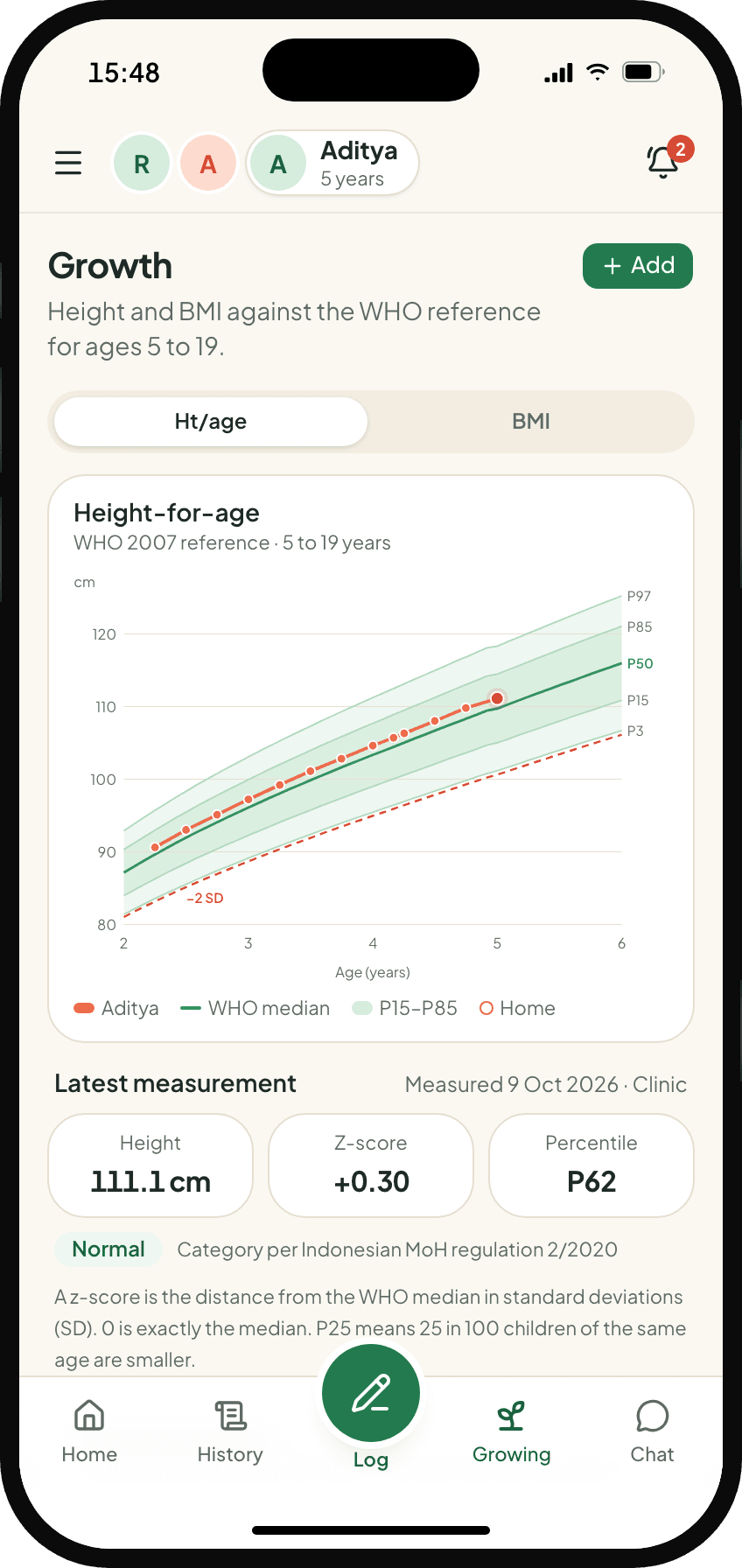
Tumbuh reads weight-for-length or height, and BMI-for-age from age 2, using WHO standards. When the curve rises past the normal range, it raises a flag and shows the food and drink data from the same period.
- ✓Flags for risk of overweight, overweight and obesity
- ✓Weight gain climbing across two lines
- ✓How often snacks and sweet drinks appear, and daily milk volume
The Ministry of Health schedule, with nothing missed.
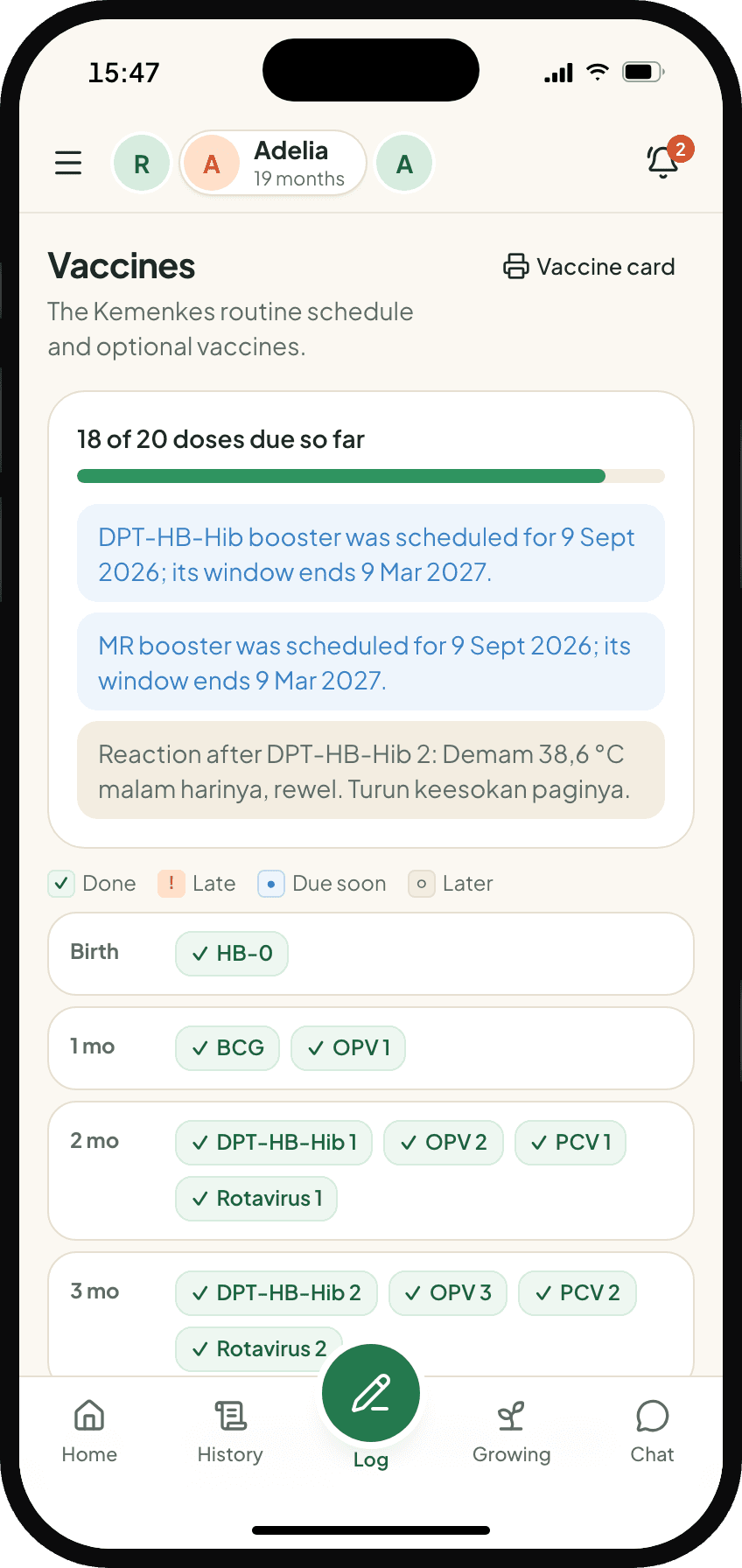
The national immunisation schedule is loaded from the start. Extra vaccines such as flu, chickenpox, hepatitis A, typhoid and dengue can be added as optional. Each dose keeps the date, brand, batch number, place and any reaction. If the last dose gave your child a fever, Tumbuh reminds you before the next one.
- ✓Every dose marked done, due or late
- ✓Vitamin A every February and August, deworming, iron supplements
- ✓A bilingual vaccine card PDF for playgroup and travel
The full story, ready for the next doctor.
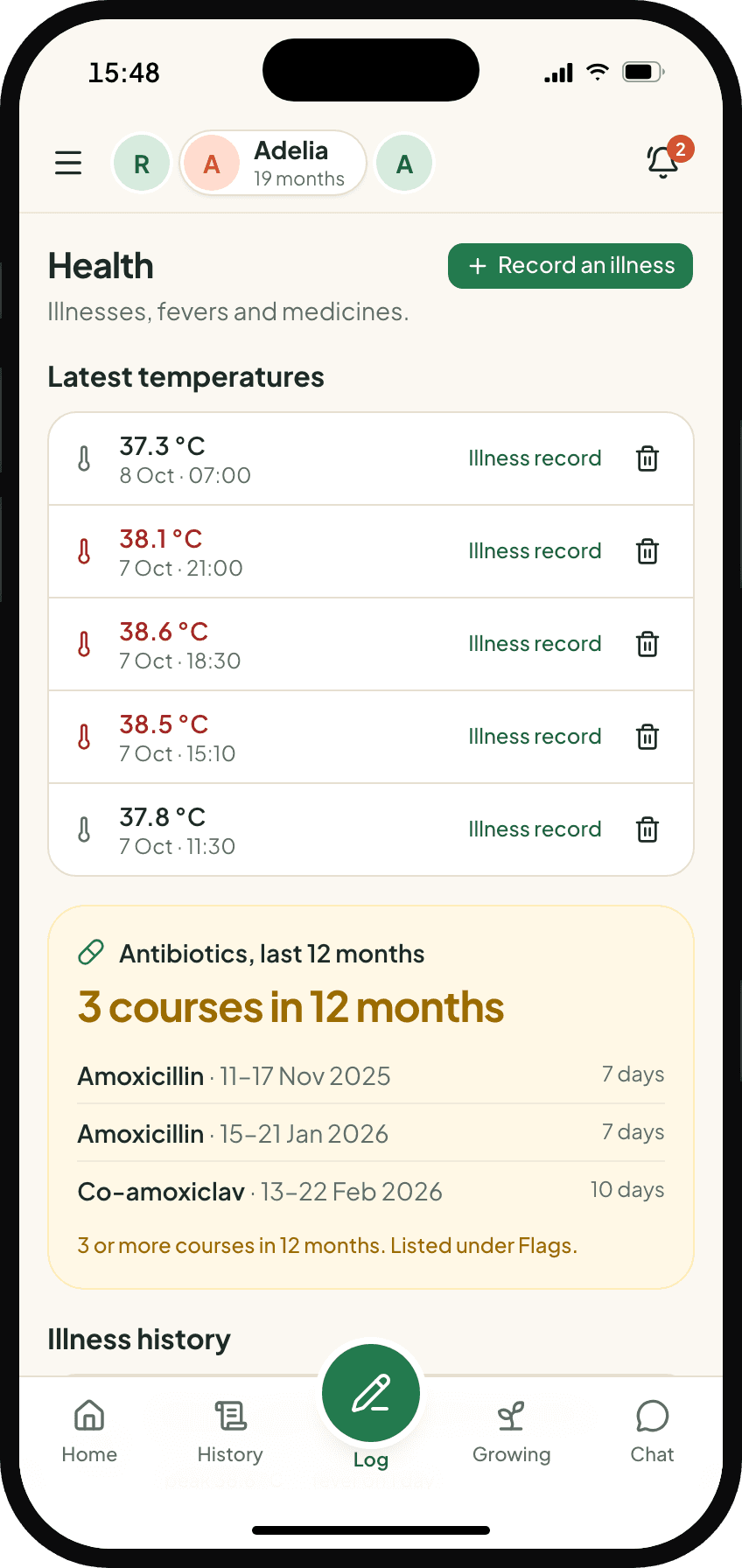
Every time your child is ill, Tumbuh records the fever curve, symptoms and diagnosis, including whether a doctor confirmed it. Antibiotics from any clinic end up in one place, so patterns are easy to spot.
- ✓A lifetime antibiotic history: drug, dose, dates and reason
- ✓Platelets and haematocrit during dengue
- ✓Temperature only shows up when it matters, such as during a fever
- ✓Regular medicines, hospital stays, ER visits, surgery and fractures
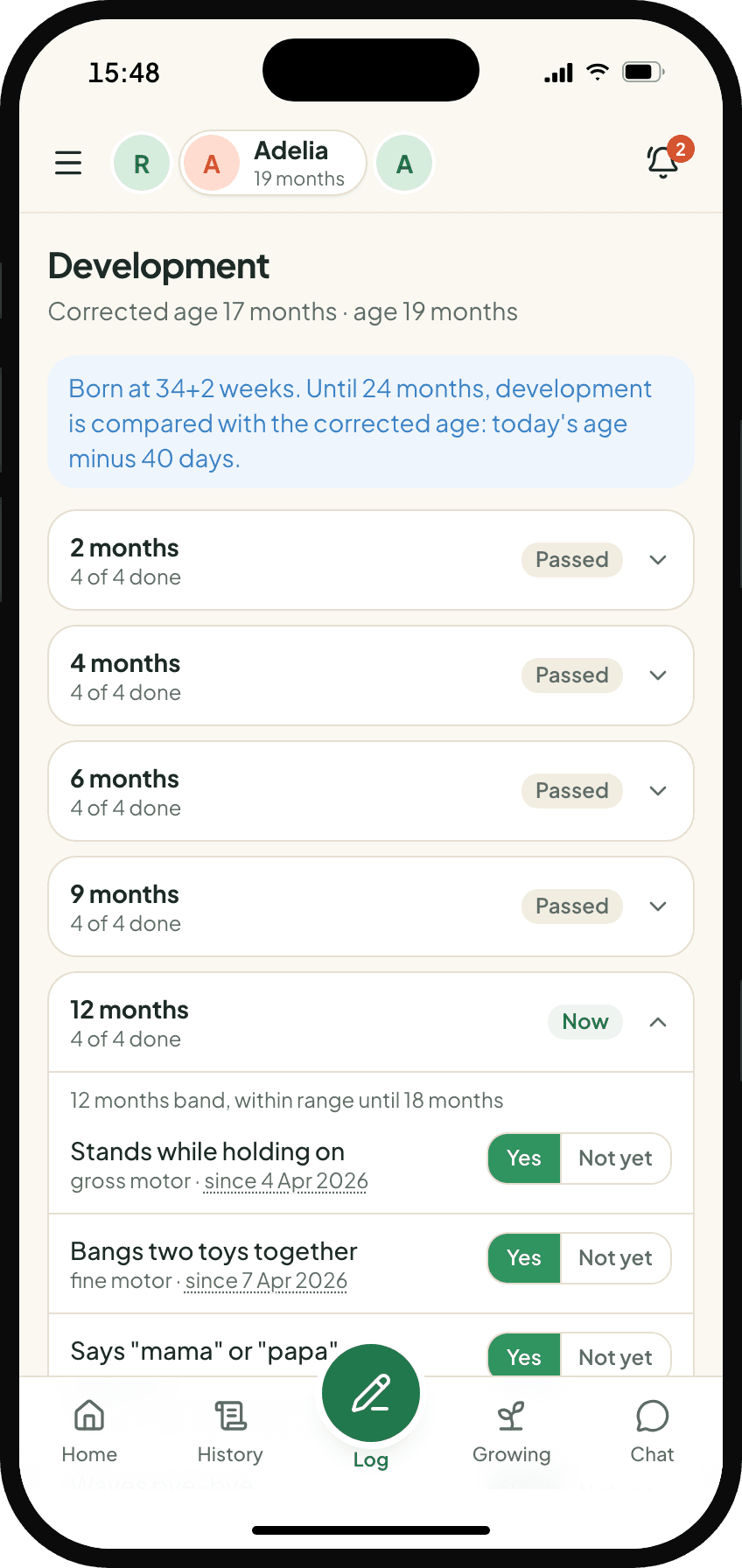
Milestones, taken seriously.
Not a memory book. Gross motor, fine motor, speech and social skills are marked “yes” or “not yet” against the normal age range, using corrected age for premature babies.
- ✓KPSP developmental screening on schedule, from 3 months
- ✓M-CHAT-R autism screening at 16–30 months
- ✓Any lost skill is always flagged
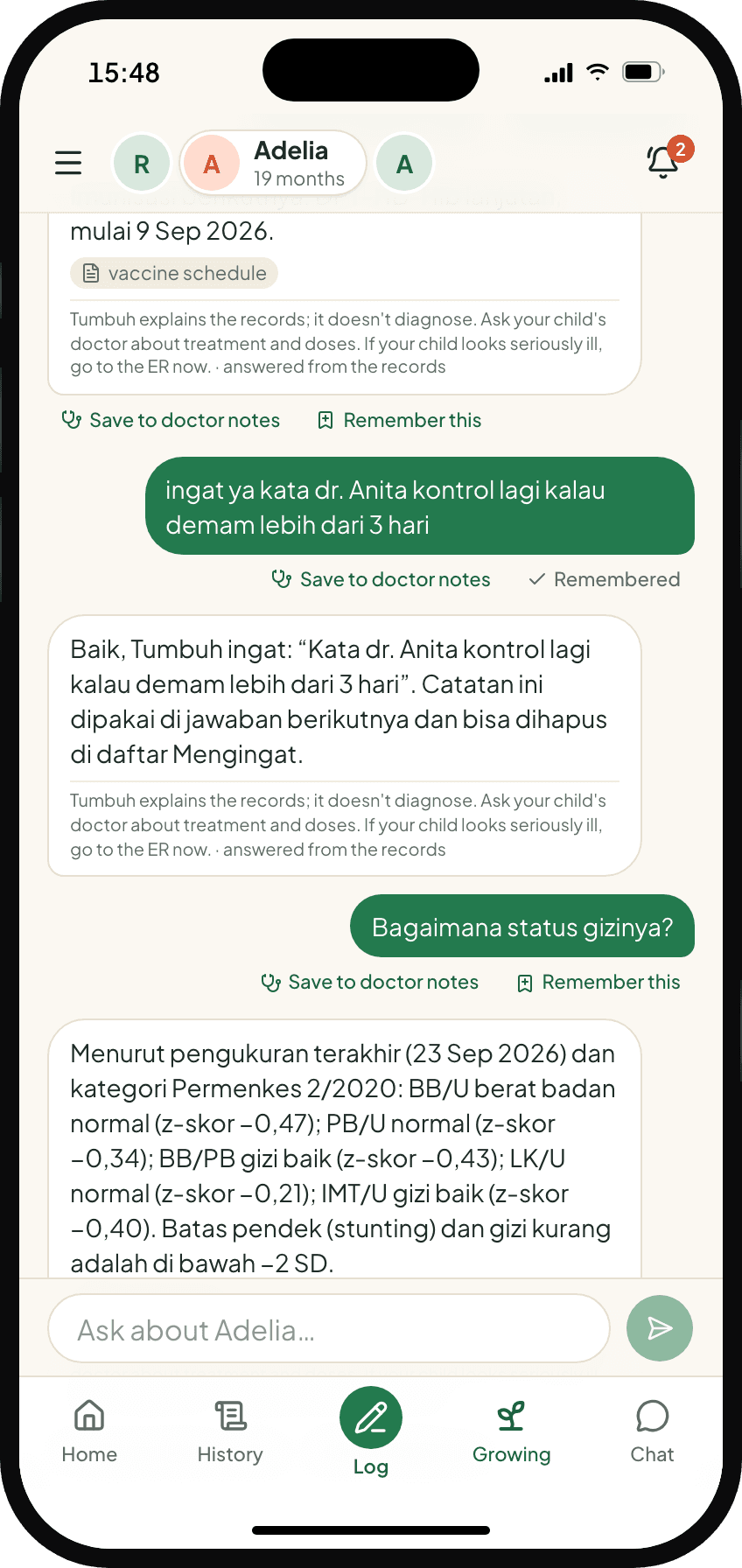
Forgot? Just ask.
“When was his last antibiotic?” “How many sweet drinks this week?” Tumbuh answers from your child's own record, with sources. Questions for the doctor go straight into the next Visit Summary.
- ✓Every answer shows where it came from
- ✓If the data isn't there, Tumbuh says so
- ✓It may mention a possibility, but never a definite diagnosis, a treatment or a dose
- ✓Dangerous symptoms go straight to emergency advice
The Ministry of Health routine schedule, loaded from day one.
Every dose has its own status: done, due soon or late. Reminders go out before each one is due.
Optional vaccines
Flu, chickenpox, hepatitis A, typhoid, dengue, MMR and any others your doctor gives. Recorded separately, and never counted as late.
| Age | Vaccines |
|---|---|
| Within 24 hours | Hepatitis B (HB-0) |
| 1 month | BCG, oral polio 1 |
| 2 months | DPT-HB-Hib 1, oral polio 2, PCV 1, rotavirus 1 |
| 3 months | DPT-HB-Hib 2, oral polio 3, PCV 2, rotavirus 2 |
| 4 months | DPT-HB-Hib 3, oral polio 4, injected polio (IPV) 1, rotavirus 3 |
| 9 months | Measles-rubella (MR) 1, injected polio (IPV) 2 |
| 10 months | Japanese encephalitis (endemic areas only) |
| 12 months | PCV 3 |
| 18 months | DPT-HB-Hib booster, measles-rubella (MR) booster |
A summary of the Ministry of Health routine programme for the under-fives. In the app, the schedule always follows the latest Ministry of Health rules.
What's switched on at each age
| Age | Main focus | Switched on automatically |
|---|---|---|
| 0–6 months | Feeding, weight gain, wet nappies, sleep | One-tap breastfeeds, bottles, nappies and sleep; weight gain speed; first vaccines |
| 6–12 months | First foods, the stunting window | Meal photos, Repeat, the Firsts list, naps, vitamin A, KPSP |
| 1–2 years | Family meals, food refusal | Food and drink photos, milk routine, naps, weight-for-length |
| 2–5 years | Picky eating, snacks, frequent illness | Food and drink photos, milk routine, BMI, illness log |
Premature babies move through the stages by corrected age until they turn 2. Entries from earlier stages stay in the history and the charts. And the record keeps working after five.
The documents you need, whenever you need them.
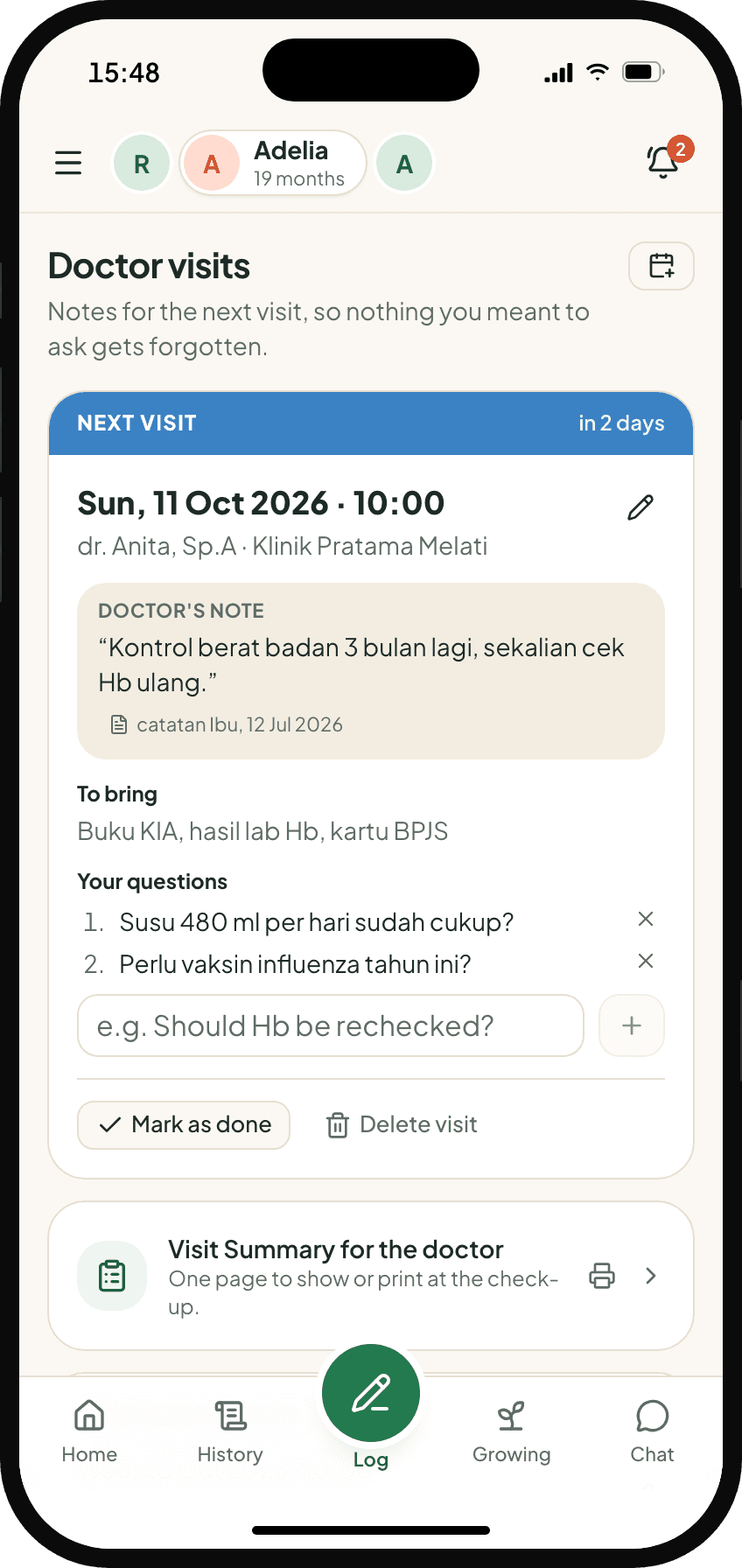
Next-visit note
The appointment, the doctor's last note, what to bring and your questions. Reminded the day before.
Visit Summary
A one-page PDF before every doctor visit. Show it on your phone or print it.
Vaccine card
A PDF in Indonesian and English for playgroup and travel.
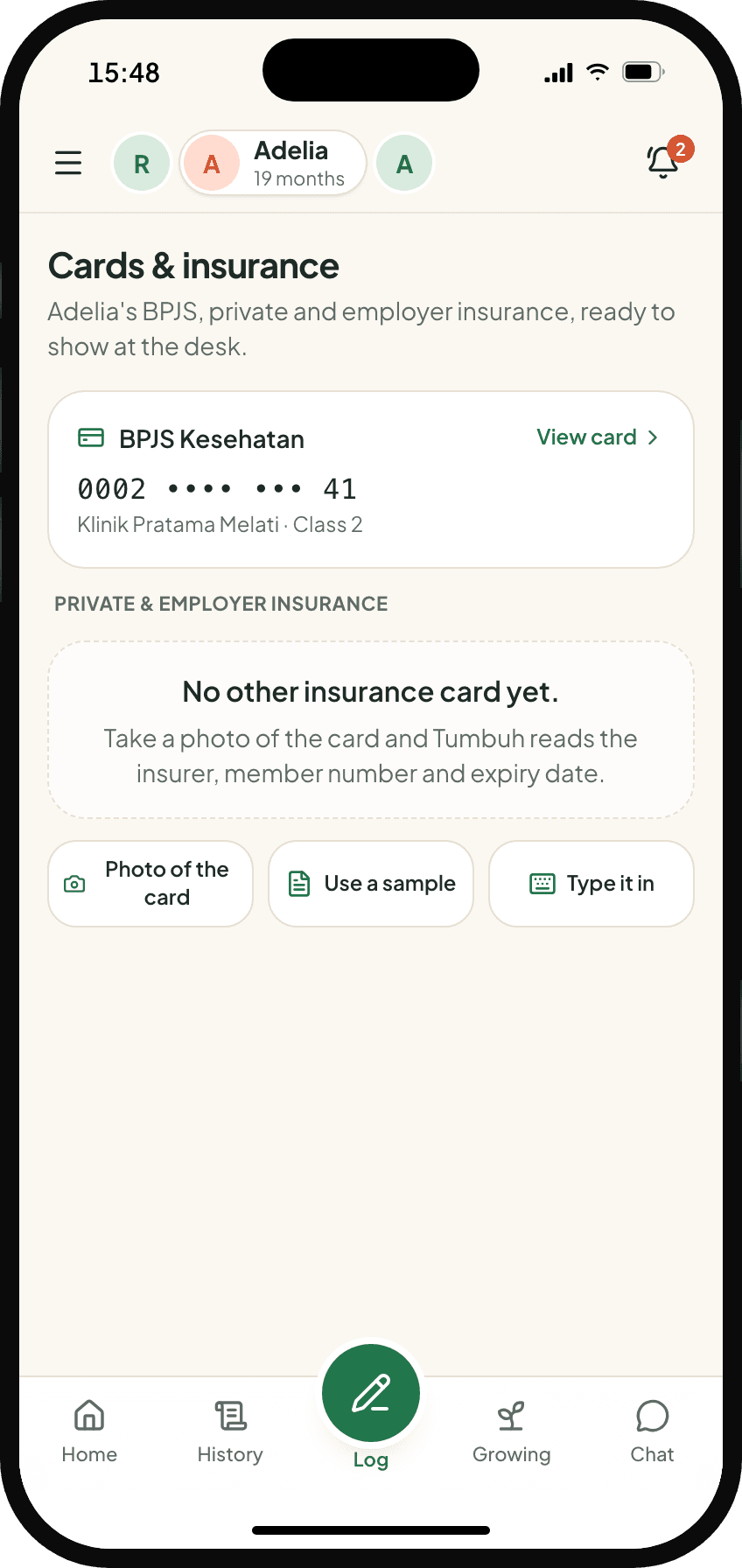
BPJS card
Snap your child's BPJS Kesehatan card and the card number and primary clinic are ready to show at every visit.
Documents & Health team
Hospital discharge summaries, hospital follow-up books, the doctor's book and insurance cards, all in one place. Your child's doctors and midwife sit in one Health team list.
Download everything
All the data, original documents and summaries. Any time.
App preview with sample data